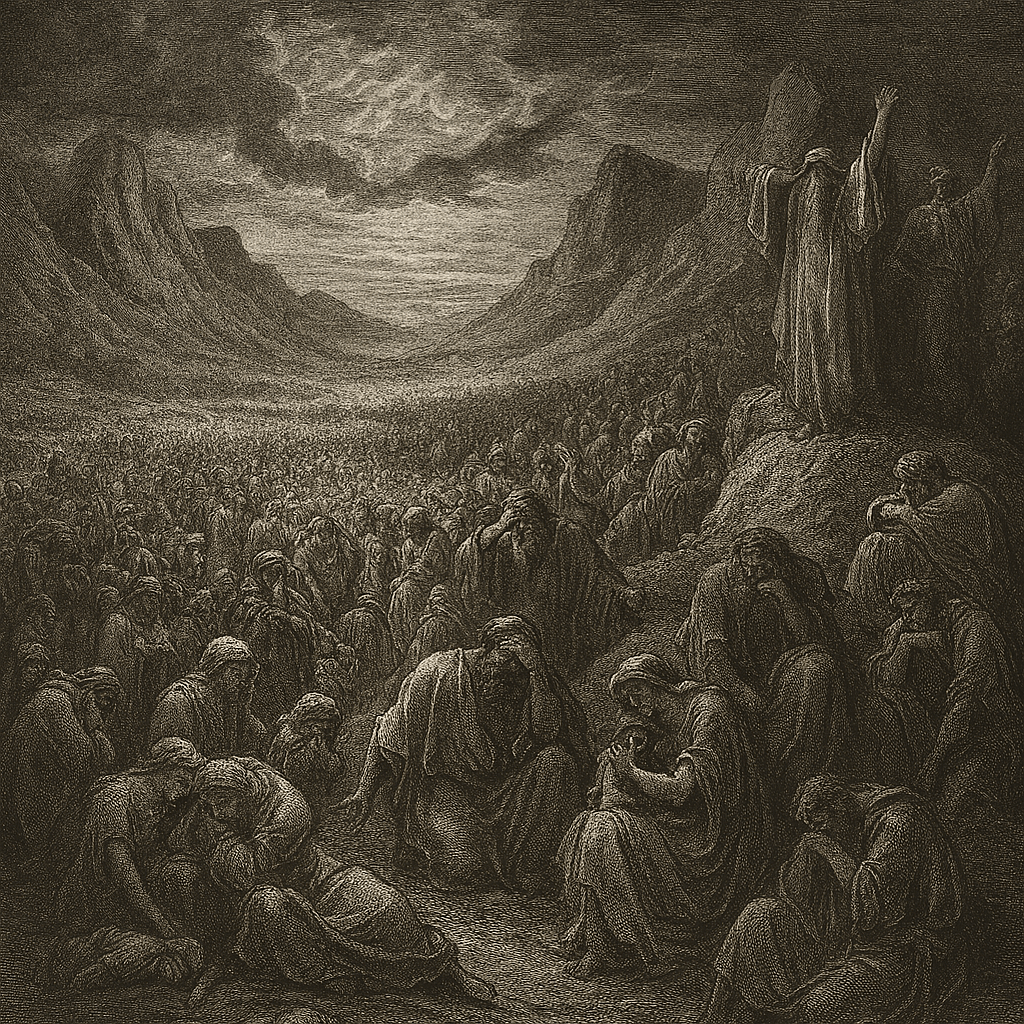
Since we are picking up from last week, I’ll give some context from Num. 13 to 14:11:
The first 10 verses of Numbers 14 recount the reactions of the Israelites to the news of 10 of 12 spies sent into the Holy Land. Spoiler, it’s NOT good.
Rundown of Numbers 14:1-10:
- Collective Despair (vv. 1-2)
- The entire congregation lifts their voices in weeping and lamentation.
- The people grumble against Moses and Aaron, expressing regret that they didn’t die in Egypt or the wilderness.
- Their crying isn’t from fear, it’s because they are rejecting of God’s leadership through His appointed servants.
- Accusation Against God (v. 3)
- They accuse Yahweh of bringing them to the land only to be slaughtered.
- The fear of their wives and children becoming plunder reveals a deep distrust in God’s covenantal promises.
- They propose returning to Egypt – basically choosing slavery over faith.
- Mutiny Brewing (v. 4)
- The people begin organizing a plan to appoint a new leader and go back to Egypt.
- Moses and Aaron’s Response (v. 5)
- They fall on their faces before the assembly, a posture of intercession and grief.
- Their reaction underscores the gravity of their rejection, it’s not just a bad idea, it’s a spiritual crisis.
- Joshua and Caleb’s Plea (vv. 6-9)
- These two faithful spies tear their clothes in mourning and speak boldly to the people.
- They affirm the goodness of the land and urge trust in Yahweh’s provision and protection.
- Their theology is clear: “If the Lord delights in us, He will bring us into this land.”
- They warn against rebellion and fear, reminding the people that the inhabitants of the land are no match for God.
- The People’s Violent Reaction (v. 10)
- Instead of repenting, the congregation prepares to stone Joshua and Caleb.
- The scene is interrupted by the visible glory of Yahweh appearing at the tent of meeting — a heavenly intervention that halts the rebellion.
We pick up our lesson in Numbers 14:11 — if you have not read yet — click here.
Decisions
Decisions are such an interesting thing. When you consider of the Hebrews allowed their thinking to be influenced SO QUICKLY by a few fearful spies… it breaks your heart. But consider how much we often fall into the same trap.
- We worry what people think about us.
- We don’t like standing out.
- We tend to prefer to go with the flow.
- We believe and stand up for people just because we like OR don’t like them.
- We allow the opinion of others to cloud our judgment…
There are definitely reasons why we should seek the wisdom of others, especially Godly leaders and wise counsel. But we must use discernment, and always know WHO we are trusting, and WHY we are trusting them.
That out of the way, we are easily influenced… and sadly not always for the best. I read once, I think Jim Rohn, said “you’re the sum of your 5 closest relationships”, likewise a similar sentiment appears in Don Quixote, where Sancho Panza says, “Tell me your company, and I will tell you what you are”. Whether we like it or not, the voices we listen to, the people we surround ourselves with, they influence us. The important question is — are they worth listening to?
Sadly we see here — the spies (10 of them) were not worth listening to. They were not living a life of trust, despite God showing them over and over that He would provide for them. Where He called them, He would not abandon them. Nevertheless, they chose to submit to fear, rather than faith.
A few warnings:
There is tremendous danger for us to fall to the influence of the majority. If the majority opinion is not in keeping with God’s Word, we have a problem.
The people had seen the Red Sea part, tasted manna, and heard God’s voice at Sinai. Yet in the face of new uncertainty, they forgot past faithfulness. This reveals a spiritual amnesia that often plagues us: we remember our fears more vividly than God’s deliverance…
I’d add that discernment is active, not passive. It requires testing the spirits (1 John 4:1), weighing counsel (Proverbs 11:14), and anchoring decisions in God’s revealed character. Passive agreement, especially with charismatic or fearful voices, is not discernment. It’s abdication.
Listening poorly didn’t just delay their journey, it redefined their generation. Listening to the wrong voices cost them the Promised Land. This underscores that influence isn’t neutral, it changes things — not always for the better.
We MUST be careful what we allow to influence us.
God’s Fame
There is a hard back and forth we see when we read Numbers 14:11-16. In this moment, Moses and God are dialoguing about the insane lack of trust among the Hebrews. It’s shocking… but somewhat more shocking is God’s consideration of eliminating the people and starting over for Moses.
The people are complaining and simply refuse to listen. But when God tells Moses this potential idea of starting over, having despised Him and not trusted Him, Moses pushes back. Moses cares more about God’s fame, God’s reputation among the nations than anything else. Moses did not want other nations questioning God’s power or His mercy. WOW.
So again, we can be quick to judge the Hebrews, lest we forget, wow… we too share this character flaw. Think about how our lack of faith, our lack of trust — despite claiming to follow Jesus — communicates to a world looking on… ugh.
It’s a question we all must wrestle with — what impact does our faithfulness to God have on our witness to the world?
Brennan Manning once wrote in Ragamuffin Gospel:
“The greatest single cause of atheism in the world today is Christians who acknowledge Jesus with their lips, walk out the door, and deny Him by their lifestyle. That is what an unbelieving world simply finds unbelievable.”
It then was added to the beginning of dc Talk’s “What if I Stumble” and became more popular and well known. BUT it is sadly true.
When we profess Jesus with our lips, when we claim to follow Him, but walk faithlessly. Oh my — what a poor witness we leave for the watching world.
Prayer
As we move into Numbers 14:17-19, we see Moses imploring God, speaking to His character to request Yahweh to do what He said He would do — to magnify His own character. It’s a wise, bold, and awesome move. Moses KNOWS the Lord is abounding in steadfast love, HESED (lovingkindness). Moses knows appealing to the mercy of God is wise both for the Hebrews, but also for God’s fame.
It’s an interesting dynamic we see unfold. One that I cannot help but wonder (in God’s sovereignty) that He wanted us to see their exchange, not to show that God can be swayed by humans in this manner, but that He is overflowing in mercy, lovingkindness is inseparable from His person even in the face of faithlessness. He cannot betray His character.
And that’s the heart of it, God’s mercy is not a concession, it’s revealing Himself. It’s not weakness, it shows His glory. Moses isn’t twisting God’s arm; he’s leaning into what God Himself has declared to be true. Yahweh wants to be known as the God who forgives, who is patient, who abounds in steadfast love. That’s not a loophole — it’s the very center of His covenantal heart.
We often think of intercession as pleading for leniency, but here we see something deeper: Moses is pleading for consistency. He’s asking God to be who He has always been. And in doing so, Moses models something profound for us — he teaches us how to pray, how to lead, and how to trust. Not by minimizing sin, but by magnifying HIS grace.
This moment also reminds us that mercy doesn’t erase consequences, but it does preserve relationship. The people will still wander. They will still feel the weight of their rebellion. But they will not be abandoned. God’s presence remains. His promises endure. His character holds. Praise the Lord for that.
Grace, but Consequences
When we wrap up in Numbers 14:20-24, we see God’s overwhelming mercy on display, lovingkindness at its best. But sadly it still comes with consequence. I mean, it makes sense, so often, even when we experience forgiveness from those we love here, consequence lingers. There is always a mark of sin remaining in forgiveness. There is a scar when there is a healed wound. Certainly the ultimate consequence has been paid for us — and eventual freedom will be given, but in this broken world — the mark of sin remains longer than we’d like.
In all of this… we see that God’s mercy is real (Num. 14:20), Yahweh specifically pardons them. It’s not partial, the covenant remains, God’s character is the same, unchanging.
But we also see that despite forgiveness, the rebellious generation will not enter the Holy Land, the Promised Land. This reminds us unfortunately that while forgiveness restores the relationship, it doesn’t always remove the ripple effects of sin… (I can think of my own missteps here with a dear friend whom I lost years of shared kingdom life, forgiveness has been sought and given quickly, but those lost years are still lost. There is a ripple effect…)
In the end, Jesus pays the ultimate consequence — this foreshadows it amazingly! Romans 8:1, “there is therefore now no condemnation for those whoa re in Christ Jesus”. Being eternally separated is no longer a threat! The wrath has been absorbed wholly. Yet we live in that “already but not yet”, sanctification still unfolds this tension — we live in grace and consequence. It’s beautiful and horrible.
Stand Firm
I think this whole lesson leaves me with a lingering “now what” kind of question. What ought I take away from this short passage of Numbers? Well, glad you asked — I think this passage begs us to consider, how do we live faithful lives? How do we prepare ourselves to remain faithful to Yahweh when the crowds around us fall to the wayside? We are certain to encounter this, I see it daily in the lives of students, friends, family, everywhere. We encounter the struggle to remain faithful in the face of uncertainty, waves of opinion, and bad advice.
SO what do we do? My goal is to remain steadfast, stand firm, raise my broken voice against the darkness — and declare who I will follow.
I will declare who I will follow, not just with words, but with the shape of my life (James 2:18, Rom 12). I will follow the One who is slow to anger, abounding in steadfast love, faithful through every wilderness (Ex. 34:6; Psalm 103:8). Even when the crowd chooses fear, I will choose trust (Num. 14:24; Psalm 56:3–4). Even when the path is unclear, I will walk forward in obedience (Proverbs 3:5–6; Heb. 11:8). Because Yahweh has not changed (Mal. 3:6; Heb. 13:8). His mercy still flows (Lam. 3:22–23). His promises still stand (2 Cor. 1:20). And in a world of shifting voices, I will anchor myself to the One who cannot betray His character (Num. 14:18; 2 Tim. 2:13).
There is a quiet grace, humility even, in choosing to be steadfast in a world that is rushing wildly toward chaos. But after all, we follow the God who creates order out of chaos (Gen. 1:2-3). We are in good hands.
I know what I want to do — but preparing helps ensure I am trusting the one who made me, not myself.
So perhaps these are some questions to ponder today:
- What voices am I listening to most right now? Are they leading me toward trust or away from it?
- How do I respond when God’s promises feel delayed or distant? Do I anchor myself in His character or drift toward doubt?
- What does “declaring who I follow” look like in my daily rhythms — not just in words, but in choices, habits, and relationships?
- Where am I being called to stand firm, even when it’s costly or lonely?
- How can I help others remain faithful when they’re surrounded by uncertainty or bad advice?
 Brian Maloy
Leave a comment