Side-note before we begin — I don’t know if this would ever be of interest to you, dear reader — but we record all these Sunday School Lessons, and this link below takes you to the recording of this morning’s lesson. I haven’t listened, I have no idea of the quality — but here it is –> 10.26.25 Lesson Audio
Intro
Really think — can you list specific ways you’ve seen the Lord be faithful, in both your life, and others? In all seriousness, if you cannot — then you are not looking, and you are not seeking to remember.
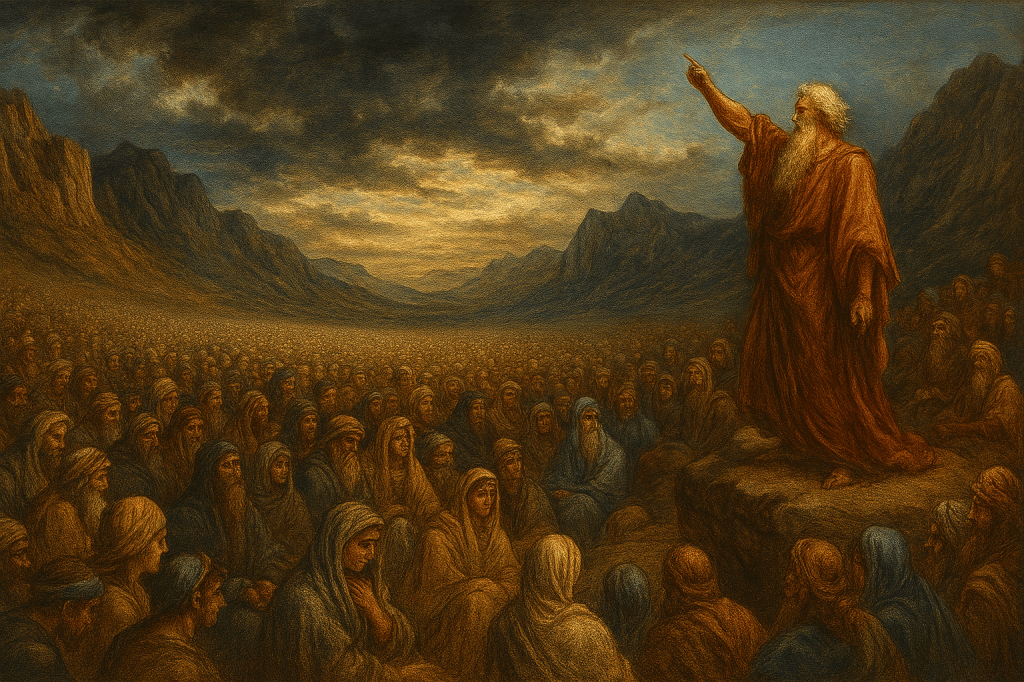
In the wilderness season of the Hebrews, we are stepping from Numbers into Deuteronomy. Yet we still see Yahweh working to help His people remember, to live IN the promise, not simply hear it and move on. Don’t just obey, remember and live within the promise. Moses is imploring them to anchor their identity in what Yahweh has done, so they can live faithfully in what He is doing and will do.
v3 — Baal Worship
What makes idolatry so appealing, even when we know it leads to ruin?
So this is curious, I’ve heard of Baal, and Baal worship many times, but this time, I noticed in reading Deut. 4:3, the mention of Baal-peor. Which caused me to do some digging to understand, and I am glad I did.
So Baal-peor simply means that this is the Baal local to Peor. Which tracks and makes sense. We see in other places of scripture how Yahweh promises to specifically be with His people in their sojourn, which we learn matters because these “so called gods” were specifically tied to a location. We could get more in the weeds, but suffice it to say, because these Baal were deeply demonic and deceitful, they are not omnipresent like Yahweh, who CAN be everywhere — but truly are limited to where they are at once. So this was a “local” Baal, specific to Peor.
There is so much more I wish we could delve into here, but alas, I have to stay focused… in the end, we have God’s people again and again led astray and into Baal worship. And since God is making mention of it here as a reminder of their previous sin and consequence, it’s worthwhile to note why — because in our own context and time, we will struggle here too.
The appeal of Baal worship likely is more deep than I’ll understand, but I do think this is relevant. The Hebrews constantly struggled with wanting to be “like the culture” around them… think about that.
- Golden Calf (Ex. 32)
- Baal of Peor (Num. 25)
- Baal & Asherah Worship (Jud. 2:11-13)
- Micah’s Idol/Syncretism (Jud. 17-18)
- Request for a King (1 Sam. 8)
- Solomon’s Wives (1 Kings 11)
I am SURE, there are other examples, those just came to mind.
The Hebrews (like us) just struggle enormously with cultural influence. The things the world assigns greatest value to, are NOT the same as what Yahweh would place greatest value upon.
> Remember — Romans 12:2 — “and do not be conformed to this world, but be transformed by the renewing of your mind, so that you may approve what the will of God is, that which is good and pleasing and perfect.”
REALLY slow down and re-read that verse. It’s true — it is about resisting cultural assimilation… of course. BUT it is more than just avoiding. It calls us to embrace a renewed mind, shaped by the Holy Spirit, one that discerns and delights in God’s will. Amen.
But back to that gross Baal worship, which was never neutral. At heart, it is spiritual warfare, where Yahweh’s people were tempted to trade holiness for idolatry, intimacy for indulgence. The Bible treats Baal not as myth, but as a real spiritual threat — a demonic system dressed in cultural relevance and earthly appeal.
Military might wasn’t even necessary to “conquer” the Hebrews here… wow. That should really challenge us to NOT forget, but remember how quickly we neglect His holiness and fall into scary patterns.
So to simplify, both the struggle for the Hebrews (and hopefully things easy for us to relate to our present context):
- Cultural appeal — to some effect, it was “taking things into their own hands”, kind of like the Garden of Eden… and trying to do whatever they thought would help ensure success — rather than obeying and living in the promise.
- Localized Baal — because this Baal was “local” to Peor, it sneakily makes the worship seem more adaptable and important — psychologically, we fall for trick like that easily. Proximity, compromise, and “specialness” are all alluring.
- False promises — Baal offered immediate gratification: pleasure, prosperity, and power. But these were empty promises, leading to ruin. The deceit lay in trading long-term covenant blessing for short-term sensual gain. Like it always does 🙂
v4-9 — Being Set Apart
I LOVE this passage, it’s like a charge to get you pumped up for a big hike or half-marathon! In Deut. 4:5-9, Moses is charging the people to live in such a way that others are influenced! If they are faithful to what God is expecting of them, they will show their wisdom and understanding — they will be seen differently.
So — are you different? Are you different from the “world” around you?
If so — is it for the right reasons?
We live in our hyper-individualist world, and seemingly every hipster is desperate to be “different” — which is crazy ironic, because what ends up being “different” and “unique” is the same as someone else trying to “be themselves”. It’s fun and humorous, but I digress. We live in a world that to a fault probably idealizes creating ourselves as an individual. That is not what I am asking or talking about.
I am asking, and trying to clarify — are we, Christians, followers of Jesus, different from the culture at large? Are we seeking to be set apart? Are we seeking to be wise and discerning.
It all goes back to God’s Word. Obeying God’s Word SHOULD set us apart from the world. If we are basically the same as the world (maybe with some Jesus sprinkles), then we need to really slow down and consider if we are really obeying God, growing in wisdom and discernment.
BUT — how SHOULD it set us apart? What can we look to as evidence in our lives? Here are some uncomfortable questions:
- If someone watched your life for a week, what would they say you value most?
- What does wisdom look like in your daily decisions, and would others recognize it?
- Are you living in a way that makes others curious about your source of hope?
- What does being ‘set apart’ look like in your friendships, media choices, or work ethic?
- Are you resisting the world’s mold — or just decorating it with Christian language (or Jesus sprinkles)?
- Where do you feel most tempted to blend in, and how might obedience help you stand firm?
Truly, this Deut. 4:5-9 charge is a call to live an obviously wise, faithful life. One marked by obedience, contagiously so!
v15-20 — Genuine Worship and Idols Today
In Deut. 4:15-20, we once again see the Hebrews instructed to “diligently watch” themselves — God knew that people, even His people, were prone to desire worshiping something visible. I mean, God makes it clear through Moses using the word ANY many times — but he still provides a list of examples of what not to worship, just to clear up any doubts.
- Human forms
- Animals on earth
- Birds of the air
- Creatures that creep on the ground
- Fish in the waters below
- Heavenly bodies
So that list, found in Deut. 4:15-20, really echos in my mind with Genesis 1. I went and looked, this is even the same categories. Clearly this is not an accident. It perfectly computes that it’s building a theological contrast: worship the Creator, NOT the creation.
Yahweh is unique, unlike Baal or other localized deities, Yahweh is not part of creation. He is above it, outside it, and sovereign over it. We ought not trade worshiping the creator, for creation (Rom. 1:25).
Think about how this list relates to today… although I do think it’s fail to build on it, we are idol factories… so we’ve got more.
- Human Forms → Celebrity Worship & Self-Idolatry
- Animals & Nature → Eco-Spirituality & Pantheism
- Birds, Creeping Things, Fish → Symbolic Idols & Superstitions
- Heavenly Bodies → Astrology & Cosmic Determinism
Easy Idols to Spot Today:
- Self & Identity
- Success & Achievement
- Money & Materialism
- Relationships
- Entertainment & Leisure
- Tech & Social Media
- Sexual Freedom
- Politics & Ideology
- Control & Risk Avoidance
- Health & Fitness
- Knowledge & Intellect
- Church & Ministry
Some of those masquerade as virtues, self-care, ambition, excellence, justice, authenticity — and some are GOOD things. But if they are more important than God, they are an idol. After all an idol is anything more important to us than God.
The Core Issue: Worshiping the Created Instead of the Creator
Paul reminds us of this in Romans 1:25:
“They exchanged the truth of God for a lie, and worshiped and served the creature rather than the Creator…”
This is the timeless temptation, to trade intimacy with Yahweh for control, comfort, or cultural relevance. Whether it’s Baal of Peor or the algorithm of Instagram, the spiritual battle remains the same.
So what do we do with this in our day to day life:
- Obedience sets us apart: Just as Israel was called to be distinct, so are we. Not weird for weirdness’ sake, but holy, wise, and compelling.
- Discernment is essential: We must train ourselves and others to recognize modern idols — not just golden calves, but addictive glowing screens, political squabbles, and misplaced loyalty.
- Memory fuels resistance: Remembering God’s faithfulness and past warnings helps us resist seductive counterfeits, lesser loves.
Wrap Up
If wisdom and discernment are fruit of obedience, what kind of fruit are you bearing?
What would it look like to live in such a way that others say, ‘Surely this person walks with God’?
Truly — are you living in God’s promise, like the Hebrews were supposed to? Are you living chasing the things of the world, assimilating to the culture around — or setting your heart and mind on things above?
Reread the last verse of our passage today, Deut. 4:20 — “But Yahweh has taken you and brought you out of the iron furnace, from Egypt, to be a people for His own inheritance, as today.”
Not unlike the Hebrews in the wilderness, through the miraculous power of Jesus, and the work of the Holy Spirit — God has plucked us from the spiritual torment of sin, freed us from slavery to sin — to be His people, to reflect His wisdom, and faithfulness to a world desperately in need of redemption.
Amen.
 Brian Maloy
Leave a comment