Intro
In reading and re-reading this section, I was reflecting and asking God to show me how this passage — the healings of Jesus, the demoniacs, the physical and spiritual illnesses shown — how it’s connected with the stories we’ve recently studied. Matthew surely was building a narrative that was purposefully cohesive, and his goal was to speak to the Hebrews and help them see how Jesus is the Messiah promised in the Old Testament. As such, this section following directly after the Sermon on the Mount is not without reason.
Likewise, Jesus’ ministry becoming more public at this point also helps us to understand the context of what Jesus was revealing about God’s Kingdom. It’s very cool — and I am grateful we get to look through this lens.
What strikes me is that Jesus was just teaching to thousands of people, and immediately following, He begins healing people — both physically and spiritually.
Let’s remember where we just came from in the Sermon on the Mount:
- In Ch. 5 — Jesus walks through the Beatitudes, deeply showing the value of people, and the upside down, counterculture nature of the Kingdom. He then reminds and reveals them of their own value and purpose in the Kingdom, to be Salt & Light to the world. They are to influence and preserve the world.
- In Ch. 5 & 6 — Jesus speaks much of prayer, love, generosity, and gets to the heart. That our inner life matters, after all, it influences our actions, words, and deeds. Being self-righteous is not the goal, being like Jesus is the goal.
- In Ch. 6 — Jesus calls us to understand our lives better. How we concern ourselves with worldly possessions, and teaches us we cannot serve two masters. Furthermore, he not only addresses the worries and anxiety of the world, but provides a way through them.
- In Ch.7 — Jesus teaches us that the way to the Kingdom is now easy, wide, and of ease — it is difficult, we must seek it out, the gate is narrow. Then He uses that metaphor to remind us we must be wary of those who influence us, not all seek to save our souls — and we can recognize those who are unsafe by their fruit. We must continue to pursue the Kingdom of God, and rest in the confidence of God’s Word (over and over and over — not just once).
Now that I’ve done a horrible job of trying to recap one of the most beautiful sermons in history…. We need to see how this weaves wonderfully into what Jesus actually begins to do in Chapter 8.
What I do think is important to see connecting the two chucks (Mt. 5-7, and now Mt. 8) is the way Jesus very clearly is going to show us His Words of love and care and calling them to the truth in the Sermon, is mirrored in the actions He takes afterward. Let’s go look!
Matt. 8:1-4
When we read Mt. 8:1-4, it’s RIGHT after Chapter 7. So people are astonished because He is teaching with authority (Matt. 7:28-29), now He is going to actually show what kind of authority He really has. And they are all curious, because after teaching, large crowds are still following Him (Matt. 8:1).
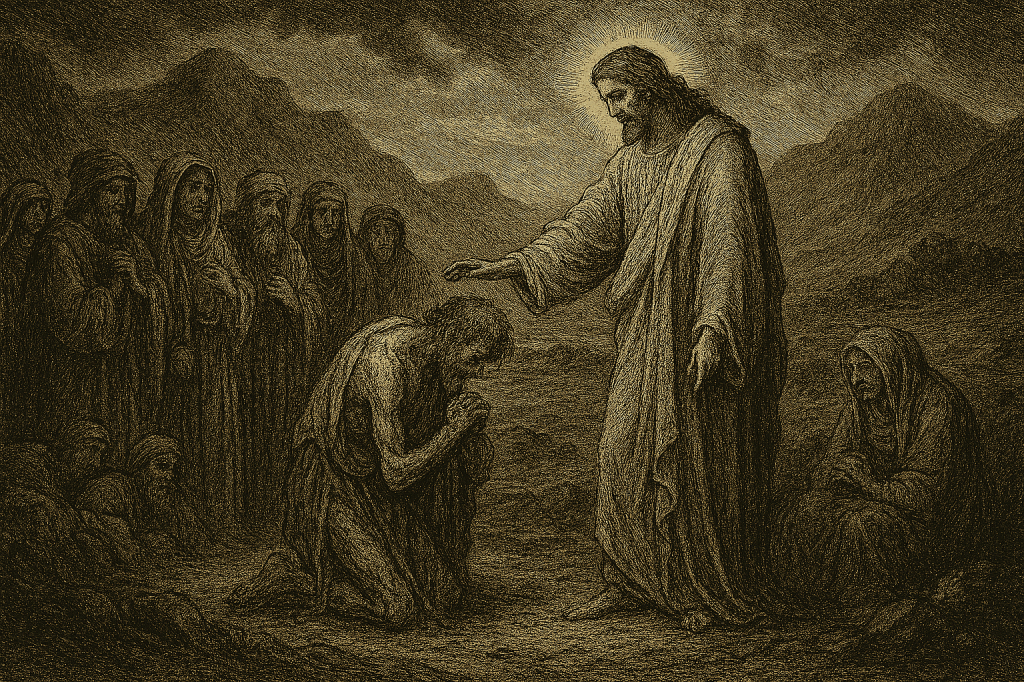
But the first encounter is awesome. A man with leprosy comes and kneels before Him. He pleads, humbly and earnestly, to be made clean — to be set free from this physical, emotional, social bondage — to get his life back. See everything for this man was gone, he was unclean, he could not participate in religious life, he had to life separate from others, he was not allowed to engage in polite society. It is heartbreaking. More than likely he was incredibly lonely, unwell, and struggled greatly.
I love how Jesus handles it. Not only does Jesus heal him, but Jesus touches him. Jesus Himself could be declared “unclean” for having touched the man, yet Jesus cares for him in such a deep way, that He touches him. I think we could probably go deeper than my thoughts initially go — but this man likely has not been physically touched for years. No handshakes (not sure if high-fives were invented, but I hope so), no hugs, no embrace, nothing. That has an effect on people, very negatively. So Jesus in effect is healing this man in a very personal, loving, shepherding manner.
Then in perfect rhythm, Jesus sends the man to the priests so he can not just BE clean, but be DECLARED clean — he gets his health back, but now he can get his life back. He can reenter His family, friends, work, community — he can have abundant life, not just survival. It is so lovely to imagine!
BUT — think about that example. Do we love like that? Do we meet the needs of others with so great a love? Jesus gently touched his hand to heal the man. Compassion, grace, mercy, love — all mingled together in a simple sincere gesture.
Think about those who “disgust” you, those who perhaps you’d avoid on the street. Think about the “outcasts”, or the social pariahs. Maybe it’s the people who annoy you most, or maybe if you’re honest… the ones you’re most likely to judge.
Do you have people in mind…? Me too 😦
Jesus reminds us vividly of something vital we forget in our world (because the world teaches a different reality) — people matter. Human beings are made in God’s image, even with the fall, we have dignity, value, and meaning. We can speak truth and healing to people with deep love — not resentment, not judgement.
(not the point of lesson, but a disclaimer?)
Don’t hear what I am not saying, we called to point people to Jesus and speak the truth. Silently affirming sin is not loving… one could make the case by “being kind” and “avoiding telling people they are mistaken in their sin”, we must not love them enough to tell the truth.
What I am saying is that when we speak the truth, we can do so with deep affection for an image bearer of God. We can love them completely, without complete understanding.
We can gently take their hand, remind them how beloved and valuable they are — and point them boldly to Jesus, as He has provided us a better way.
Matt. 8:14-17
So sadly we have to bypass the story of the faith of the Centurion — which is an amazing moment of faith, I love it. But we pickup in Mt. 8:14 where Jesus heads to Peter’s home, and see’s his mother-in-law in a bad state. Again, Jesus touches a hand, and the illness leaves her immediately. Jesus is showing authority again, over the physical ailments of this world. In fact, the healing is SO complete and immediate that she hops up into hospitality mode — truly a miracle. I don’t know about you, but after my last ear tumor surgery… I was a little “out of it” for a bit. HA, in fact my 5 hour stay in recovery because I handled the anesthesia so poorly is certainly laughable now — needless to say, I was not quick!
But zoom out a bit again. The man with leprosy was an outcast, not valuable to the world around him. Likewise, women were not valued as they should have been in their culture. Jesus simply approaches those in need of healing as image bearers, worthy of love, healing, and new life. Praise the Lord.
Then we open a whole other can of worms, both mysterious and awesome, and comforting in how powerful Jesus shows Himself. Mt. 8:16 says when evening came, many were brought who were demoniacs (possessed by demonic spirits). Jewish leaders attempted this in their world, but with no authority like Jesus. We could hover here for a long time — but alas, it’s not the main goal of this week’s lesson, there is a bigger meaning for us to grasp.
Think about this in Mt. 8:16, “and healed ALL who were sick”: the very fact that Jesus could heal all brought to Him who were sick shows us that no disease could thwart His healing powers. Nothing physical, spiritual, emotional, social — had authority Jesus could not conquer and prevail over. Again, Praise the Lord.
When I was reading, I noticed this note in one of my Study Bibles (if you don’t have a paper or digital Study Bible… get one — if you need recommendations, ask me! I have a few favorites) —
Note on 8:17 (CSB Study Bible):
“In one sense Jesus was able to heal physical illnesses because his impending sacrificial death purchased spiritual atonement from sin. All sickness is ultimately a consequence of Adam’s sinful choice. Jesus could remove these consequences because he would bear the full penalty for sin on the cross. Matthew’s application of Is 53:4 shows that he understood Jesus’s death as an act of substitution, an atonement in which Jesus was “pierced because of our rebellion” and bore punishment “for the iniquity of us all” (Is 53:5-6).”
WOW — what an awesome connection. I knew that, all sin, brokenness, etc is an effect of the Fall. But to connect how Jesus is making this right — Jesus is removing these consequences one by one right here — but it is pointing to the ultimate work He will do on the cross. Dear reader — DO NOT MISS THIS. Jesus is fulfilling and setting things right. He is directly challenging (and showing authority over) the darkness, the sin, the brokenness, the hurt, and pain of this fallen world. He is bringing restoration to the world. He is bringing healing to the world. He is bringing God’s people back to Himself, into the Kingdom. In this, He is not just making thing right again, but also fulfilling the prophecy when God spoke through Isaiah, Jesus is literally doing what God said He would do — taking on our weaknesses, our iniquity, our sin.
Praise be the Lord. He is good to us, far more than we can fathom.
Matt. 9:1-8
The last section we look at today is great — the man who is paralyzed, and his loving friends bring him to Jesus. (Note how I phrased that… in his brokenness, his friends did not leave him, they loved him enough to bring him to Jesus — to be healed…)
It’s such a curious moment here. Jesus explains WHY He does what He does — but it’s still odd. I am probably still figuring it out. Jesus sees the faith of the man’s friends, and He kindly tells the man, “your sins are forgiven” — which is amazing! But probably not the exact healing that his friends had in mind initially. Regardless of that, Jesus says first (on purpose) that the man’s sins are forgiven. In that way, Jesus heals the man. You see, I think we live in a very material world — we process based on what we see, hear, experience, etc. We don’t always remember and live in light of the spiritual realities around us. Jesus knew the heart, and YES the man needed physical healing, freedom from his physical bondage — but he also needed freedom from his spiritual bondage.
My theory, which I hope I am saying with orthodox doctrine — Jesus was proving to them all, the religious leaders watching, the man himself, even Jesus’ Disciples (us too) — He did not come just to meet the physical needs of people, to heal the physical issues, Jesus came to also spiritually heal people. He cared about the WHOLE person, holistically we might say. Mind, body, and soul.
Maybe that is not profound to you, I KNOW this, I HAVE known this — but considering it from this angle, and thinking about it this way is amazing. It gives much more depth to what Jesus is doing here, the order, and the words He uses.
Obviously the religious leaders lose their cool… shocker. But Jesus is trying to help them understand this truth too. He is the Son of Man, the prophesied one they’ve been waiting for. He was proving His power, and His authority. And it may not be clear to us at first glance — but it’s definitely clear to them what Jesus is saying.
Wrap Up
There are so many ways we could go here — but I love the core thing I have floated back to in this lesson. We see story after story, vignette after vignette, of people coming to Jesus, encountering Jesus, and being brought to Jesus for healing. Jesus does not just say nice things, He doesn’t just heal them, He gently takes their hands, sees them as a human being made in His image, and in sincere love, He heals them physically and spiritually. What a massive blessing and gift to witness, even 2000 years later.
We can all learn from this. Every single one of us.
We can learn to love people enough to speak the truth, and bring them to Jesus. Not just tell them they are wrong and sinful, but to bring them to Jesus.
We can learn to seek the Lord when we are hurting, in need, living in pain, struggling with darkness and sin. We can bring our brokenness to Jesus.
We can learn from Jesus the authority in His Word, that the Word of God (Jesus Himself), is a wellspring of life — it heals, it corrects, it draws us nearer to the Father.
In Matthew 8 though, we witness a profound demonstration of Christ’s redemptive work. These healings are miraculous events, but they are also living parables of God’s restorative plan. Jesus doesn’t just address the surface and symptoms; He gets to the core of human brokenness, offering actual real lasting restoration.
Key Takeaways:
- Jesus sees the whole person — physical, emotional, and spiritual needs are interconnected.
- Compassion is an active thing — love moves beyond sympathy to transformative action. I read one, difference in accepting love and transforming love.
- Christ’s authority transcends human limitations — no condition is beyond His redemptive touch.
Charge:
Bring your brokenness to Jesus, truly nothing is too much for His healing.
See people as image-bearers worthy of dignity and hope.
Demonstrate Christ’s love through compassion and engage with truth.
Remember: These lovely stories of healing are lived examples of God’s ongoing work of restoration. As Christ’s disciples, we are called to participate in this ministry of restoration (between God and man), reflecting His love to a broken world desperately in need of hope, healing, and redemption.
 Brian Maloy
Leave a comment