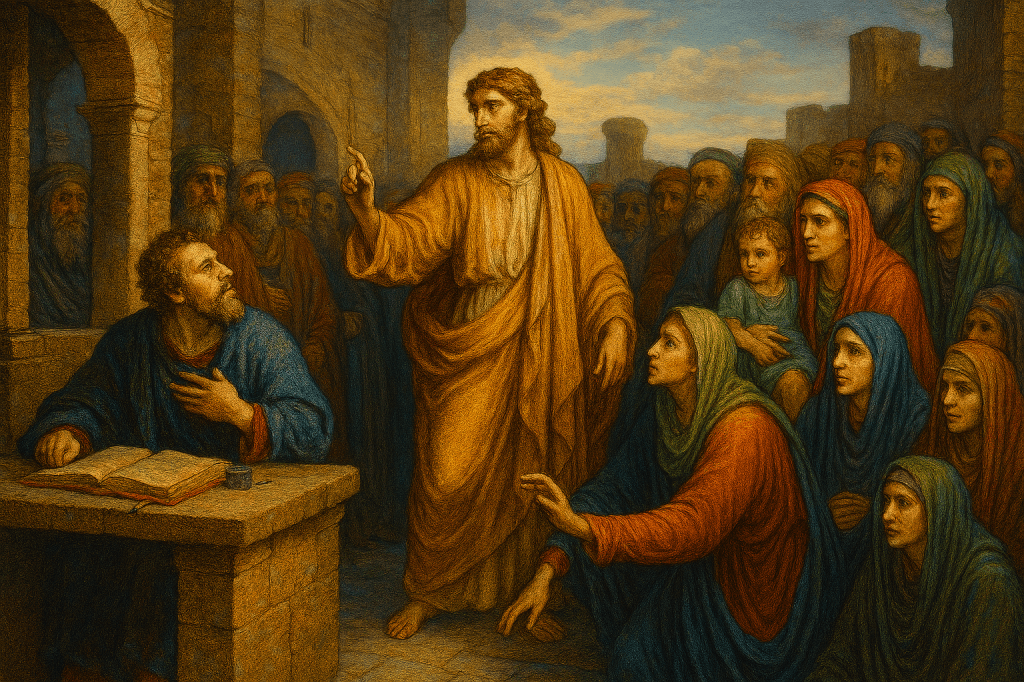
As always, there is a lot in our passage this week — and it’s excellent.
We just stepped a few weeks ago out of the Sermon on the Mount, and Jesus’ ministry has officially begun publicly. We have to recap a bit from last week (because it’s been a couple weeks with the snow).
Things we walked away with last week:
- We can learn to love people enough to speak the truth, and bring them to Jesus. Not just tell them they are wrong and sinful, but to bring them to Jesus.
- We can learn to seek the Lord when we are hurting, in need, living in pain, struggling with darkness and sin. We can bring our brokenness to Jesus.
- We can learn from Jesus the authority in His Word, that the Word of God (Jesus Himself), is a wellspring of life — it heals, it corrects, it draws us nearer to the Father.
Last Week’s Reminder: These lovely stories of healing are lived examples of God’s ongoing work of restoration. As Christ’s disciples, we are called to participate in this ministry of restoration (between God and man), reflecting His love to a broken world desperately in need of hope, healing, and redemption.
Why I made us recap that some — we are going to continue down that same thread, with more stories of Jesus’ interactions, and miracles. We’ll get to understand better the mercy and love of Jesus, and how completely He lived within His Father’s will — and just to beat a dead horse… He is fulfilling the Word that had been spoken, which was indeed Him, He was, is, the Word — yet here he is physically living it, fulfilling it — oofta.
We do pick up with some brief context of where we have been and where we are going. Jesus clearly just showed us in the previous chapter how deeply He cares for the hurting, broken, and lost. Last week was the man afflicted with leprosy, Peter’s MIL, and the paralytic. Incredible moments of Jesus living out what He just taught on the Mountain.
Everyone loves someone who heals those with physical ailments — but Jesus is going to show that He came to heal far more than some physical ailments. And while we say last week that Jesus’ healing literally gave those folks back their lives — He is going to show us more fully now.
*which indulge a nerdy connection – think about Moses going up to the Mountain to be taught and prepared by Yahweh in the wilderness. He was being shown the way so he could teach the people and lead them to live as holy and set apart in the Promised Land when they entered. Likewise, Jesus walks up a mountain, but now brings the people with Him, and He Himself is God, and is instructing them how to be transformed for the Kingdom through the Word — but He is building His people, preparing them to live within the Kingdom. I am not doing that justice… but it’s a really neat thought.
Matt. 9:9-13
Think about the emotions you feel regarding stories of suffering, pain, brokenness? How do you respond to it? Consider this — everyone wrestles differently with grief and pain. Both outwardly and inwardly. We rarely can completely understand the hardships others face.
Sometimes we are in a place of grief and sorrow, other times we are watching those we love (or those we know) suffer greatly.
Q: What do we do with that? How do we show mercy? How can we bring those hurting into the light of the Kingdom?
Given that thought — let’s re-read Matt. 9:9-13.
Question: What is Jesus doing? Why is He showing such mercy to someone on the fringes of society? Especially when they potentially CHOSE this life…
A few things we can observe and infer here:
- Matthew wrote this Gospel, and he doesn’t give tons of details about himself here.
- Matthew would have been very fastidious, trained to be meticulous with records and figures. I think fair to say, a very calculated individual.
- We have no indication that he knew Jesus, or his ministry prior to his calling. It’s possible, Capernaum wasn’t huge, but nothing is stated.
- Yet when Jesus speaks to Matthew, “follow me”, he got up and followed.
Right after, Jesus is with Matthew and His disciples, at a dinner party with some of Matthew’s friends. Specifically stated to be other tax collectors and sinners. WEIRDLY the Pharisees see this? (mystery of how, but fair to say that Jesus wanted them to if it happened) Naturally they inquire as to why Jesus would do such a thing…
Jesus replies with:
“It is not those who are well who need a doctor, but those who are sick. Go and learn what this means: I desire mercy and not sacrifice. For I didn’t come to call the righteous, but sinners.”
Jesus quotes a well-known proverb first, about the sick needing a doctor, not the well — but then quotes Hosea 6:6, and tells them to go and learn what it means:
“For I delight in lovingkindness rather than sacrifice, and in the knowledge of God rather than burnt offerings.”
— Hos. 6:6 LSB
What can we take away?
- The Pharisees believed themselves to be righteous, having followed all laws and traditions outwardly.
- The outcasts knew they were not righteous.
- Jesus is helping them to see — in living parable format, salvation could not come to the self-righteous.
- Only those who truly recognize their need for a Messiah, can find restoration.
- Jesus is really rebuking the religious leaders for their lack of compassion and spiritual arrogance. Yikes.
I heard it said a long time ago, when your sin is small, your Jesus is small. And we are so apt to make light of our sin, downplay and justify it — well run that down the track — why do I need a savior if there is nothing I really need saving from? But when my sin is big, oh man — my Jesus is big. I see the deep need for a Savior capable of redeeming even me.
So when we consider that Jesus was friendly with sinners, we have to ask ourselves, what does it look like today, to be friends with sinners?
Even if that question makes us a bit uncomfortable — we who follow Jesus want to live as He lived, and we have to ask ourselves tough questions (and lean into the Holy Spirit to help us).
Try to see them like Jesus did:
- Jesus saw beyond their bad choices.
- He sees the wound beneath the behavior.
- He could spot the image of God beneath the rebellion.
- He saw the sickness beneath the symptoms.
- And He knows that only those who recognize their need can receive healing.
- The Pharisees couldn’t see that. It’s easier to see people in categories.
- Jesus helps them/us to see people, as people — made in His image.
Think about how Jesus answers the Pharisees: He quotes Hosea 6:6 — mercy over sacrifice.
Sacrifice is easy: > rules, rituals, boundaries that keep us safe and clean.
Mercy is costly: >time, presence, patience, compassion, and the willingness to be misunderstood.
Over and over, Jesus chooses mercy. BUT ALWAYS direct them to the Kingdom, living within His order and rhythm — He never leaves them in their brokenness alone, without a way out.
Matt. 9:14-17
So to that point, what is Jesus really offering? He is coming up against the religious folk here — so what does He offer that religion does not?
Perhaps we have to answer — what is “religion”?
Well the Pharisee’s had become SO intent on the perfect keeping of rituals that they had neglected showing mercy to others. Arguably, I think you could make a case for their over-focus on the law, tradition, and rituals, and a lack of understanding the whole of God’s Word (which Jesus regularly cited for them to try and awaken their minds and hearts)
It’s hard not to see the connection between Jesus’ conversation with the Pharisees in Matt. 9:12-13, and then immediately following, the conversation He has with John the Baptist’s followers.
So in Matt. 9:14-17, Jesus is asked about fasting. He proceeds to answer the question in metaphor. Which also confuses me… ha!
Obviously Jesus is not opposed to fasting, He fasted Himself (Matt. 4:2) but He believed that a person should fast only when the occasion warranted it, not out of “mechanical ritual”, or legalistic rationale.
If we think about those metaphors — it’s rather like Jesus is saying, “existing religious structures of the day cannot contain the new wine of the Gospel”. It’s a cool concept to be sure.
In the end — Jesus wants them to understand, the new covenant required a new way of thinking. The old system (which He came to fulfill), would not suffice in the Gospel’s message of salvation by faith alone, through Jesus alone.
Matt. 9:18-26
Think about when you have felt like you didn’t know where to turn… What did you do? How did you handle it? Hopefully we have the kind of faith we see next.
If we pay close attention — we read that “one of the leaders” came to him running that his daughter had died. We learn from Mark & Luke this is Jarius, who was indeed a leader in the local synagogue.
What’s so cool, and super easy to miss in the narrative — Jarius is the type of religious leader that Jesus refers to in His previous statement that the legalistic order of the day cannot truly understand and embrace the Gospel. YET, Jarius comes running — in his moment of hopelessness, he ran to Jesus. He completely throws off the order and legalism of the culture, bucks the system of which he is a major part, and runs to Jesus. He runs to Jesus because he had faith that Jesus could bring back his little girl.
So if we pause and linger here — Jesus is literally talking about the need for a larger view of God’s Kingdom, and in bursts a man from the “old guard” who represents the small view of God’s Kingdom — yet he is throwing off that thinking, and willing to trust Jesus, and believe in His power. It’s amazing!
But in between, in Matt. 9:20-22, we get this little glimpse, WHILE Jesus is on His way to Jarius’ daughter — of a woman who is desperate for healing, knowing if she just touches His robe, she will be healed. And beautifully, her faith indeed heals her. She is restored. It’s this short incredible moment, ON THE WAY to another wonderful resolution.
So back to that question — when have you felt completely out of control, not knowing where to turn, or who to turn to… we should follow the lead of Jarius, we should run to Jesus too. We can take our concerns, BIG and small — to the one who actually truly knows our hearts, goodness — He made our hearts.
QUESTION:
When we read stories like Jarius and his daughter — it should be the kind of thing that rattles our faith. Not at all in a doubtful manner, but in a “do I run to the Lord with such hope, such faith, such trust?
In so many ways, hopelessness tends to strip us down to what we REALLY believe. Jarius is a man with status, structure, and a system that should have given him answers. Yet when his daughter dies, none of that can help him. His position can’t save her. His reputation can’t save her. His religious system can’t save her. We’ve ALL been there before. We’ve all been Jarius, having built a whole life of systems and answers — in the end, it falls apart when it’s apart from Jesus.
But then we see the women with bleeding, she’s hidden, alone, quiet, unseen, unclean, has no voice, no position — and she quietly approaches the Lord, and He not only heals her, but brings her out of the darkness into the light. He gives her dignity back too.
SO AGAIN — what is your reflex?
- Do we run to Jesus like Jarius, throwing off pride, reputation, self-sufficiency?
- Do we reach for Jesus like the woman who believed that even the smallest contact with Him is enough?
- Or do we try to manage it ourselves, hold it together, keep up appearances, or numb the ache?
These stories SHOULD help us, to draw us nearer to the one who can give us hope, who can heal us, who can save us.
They show us what faith looks like when everything else falls away. They show us a better way…
Wrap Up
When you step back and look at all these stories together — Matthew the tax collector, the Pharisees, the question about fasting, Jarius, and the bleeding woman, I think a theme rises to the surface:
- Jesus restores what religion cannot.
- Jesus heals what self‑sufficiency cannot.
- Jesus welcomes those whom society will not.
- And Jesus calls us to trust Him in ways we often do not.
Every person in Matthew 9 shows us something about the Kingdom:
- Matthew shows us that Jesus calls the unlikely, the unwanted, the morally compromised… and His call creates a new life.
- The Pharisees show us how easy it is to cling to rules, rituals, and appearances while missing the heart of God.
- The question about fasting shows us that the Gospel cannot be squeezed into old categories or old wineskins — it requires a new heart.
- Jarius shows us that even the religious, the respected, the structured, the “put‑together” eventually come to the end of themselves, and the only place left to run is Jesus.
- The bleeding woman shows us that even the hidden, the ashamed, the overlooked, the unclean are seen, known, and restored by Jesus.
And all of them together show us this:
The Kingdom of God is not for the self‑righteous.
And He is still the One who says to every single one of us:
“Follow Me.”
That is the better way.
That is the way of the Kingdom.
And that is the way of life.
What would it look like for us to run to Jesus today with the same honesty and desperation as Matthew, Jarius, and the bleeding woman?
> I pray the Holy Spirit helps us live lives just like theirs. I pray He gives us the grace us to more fully follow Him, day by day.
 Brian Maloy
Leave a comment