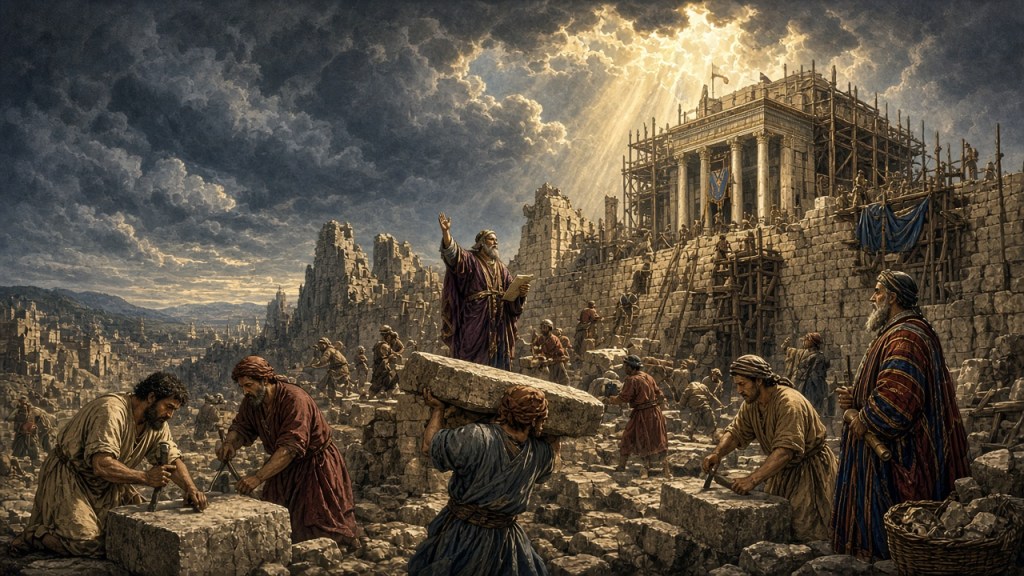
Week 11 — we did a Recap of the last 10 weeks studying Ezra & Nehemiah. While it was definitely a fly-over view, it was a good moment for us to reflect on everything we’d learned, studied, and wrestled with over the last quarter. I was sincerely blessed by our study together on Wednesday Nights.
Below is the Audio to listen to lesson, the transcript to read (unedited), and the auto-generated summary.
Audio Recording
Summary (auto-generated)
Final Session Overview: A 10-Week Study of Ezra and Nehemiah
This final session serves as a comprehensive wrap-up for a three-month study on the books of Ezra and Nehemiah. The leader distributed a multi-page summary document designed to help participants retain key lessons, major themes, and Christological connections, with a specific focus on prayer for the church.
One-Sentence Summary of the Study:
God initiates renewal by stirring His people to leave lesser kingdoms and return to wholehearted worship, rebuilding their lives around and according to His word.
Recap of Key Chapters and Events
- Ezra 1–2: God stirs a pagan king to facilitate the return of God’s people. The exiles leave the comfort, wealth, and security of Babylon to return to a destroyed Jerusalem, trusting in God’s initiation of their renewal.
- Ezra 3–6: The altar is rebuilt first to prioritize worship. Despite opposition and discouragement, the temple foundation is laid and eventually completed, allowing for the proper celebration of Passover and the resumption of right worship.
- Ezra 7–8: Ezra set his heart to study, do, and teach the law. God’s word became the anchor and center of all their rebuilding efforts.
- Ezra 9–10: A period of difficult repentance where the community addressed the serious issue of intermarrying with unbelievers. This highlighted the non-negotiable nature of dealing with sin to maintain pure worship.
- Nehemiah 1–2: Nehemiah is burdened by the state of Jerusalem, leading to months of fasting and prayer. He secures permission from King Artaxerxes to return and inspect the city. His leadership was characterized by humility and pointing others back to God.
- Nehemiah 3–4: The physical rebuilding of the wall faces intense opposition from neighbors (Sanballat and Tobiah). The builders worked with both tools and swords in hand, ready to defend and labor.
- Nehemiah 5–6: Social issues, including the exploitation of the poor by wealthy nobles, are addressed. The wall is completed in 52 days. A key theme emerged regarding the “fear of God versus the fear of man.”
- Nehemiah 7–8: Ezra reads the Law to the people for hours, and the Levites explain its meaning. This distinguished between merely “knowing” scripture and truly understanding it in the heart.
- Nehemiah 9–10: The community engages in a “national confession of sin,” retelling Israel’s history from Abraham to their return from exile. They recognize that their ancestors’ failures must be confessed to avoid repeating them, leading to a renewed covenant and commitment.
- Nehemiah 12–13: The wall is dedicated with loud praise. However, the book ends on an “unfinished” note: Nehemiah returns to Susa, and the people eventually drift away. When he returns to reset their course, he acknowledges imperfection. This deliberate incompleteness points to the need for a greater completion, which is found in Jesus.
Major Themes
- God Initiates Renewal: God takes the initiative to stir hearts (both kings and people). We are not in control; God is. Jesus completes the renewal that human leaders could not.
- Worship First: The people rebuilt the altar before the wall. This serves as a reminder to pause and worship God for His work rather than immediately jumping into “to-do” lists.
- Sola Scriptura (God’s Word at the Center): God’s word is the ultimate authority above any worldly ruler or institution. In John 1, the Word became flesh—Jesus is that ultimate authority.
- Ordinary Faithfulness: While leaders like Ezra and Nehemiah are highlighted, God used the “ordinary, unseen faithfulness” of regular people (referenced in the genealogical lists) to accomplish His work.
- Opportunities and Costs of Obedience: Leaving Babylon (comfort) for Jerusalem (hardship) requires costly obedience. In an “opportunity cost” framework, genuine obedience to God often requires sacrificing comfort, convenience, or security.
- Grief Turning to Joy: The study noted several instances where initial weeping (due to lost worship or realization of sin) was turned into joy and rededication by the leadership of the Levites and God’s grace.
Christological Connections (Typology)
The study emphasized typology—the study of “types” in the Old Testament that foreshadow Jesus.
- The Unfinished Work: Every leader in Ezra and Nehemiah falls short and the work requires restarting. This leaves a void that only Jesus, the “finisher” of our faith (Philippians 1:6, John 16:7), can fill.
- The New Jerusalem: The reconstruction of Jerusalem in the Old Testament points forward to the New Jerusalem coming down from heaven at the end of time.
- Types of Jesus: Figures like Moses, Joshua, Joseph, and Nehemiah serve as types that point toward the ultimate work of Christ.
Discussion: Big Questions and Personal Application
The session included interactive discussion on how these themes apply to modern life, particularly within the context of a broken world.
- The “Hallway” Danger: A poignant metaphor described the moment a worship or study session ends and participants walk into the “hallway” of daily life. It is easy to forget the “kernels” of truth wrestled with during study. The challenge is to hold on to these insights through the chaos of daily life.
- Expectation of Opposition: Both internal (discouragement, sin, delay) and external (mockery, threats, false prophets) opposition are inevitable. The lesson is to turn these burdens over to the Lord rather than carrying them alone.
- Costly Repentance: The study distinguished between “cheap repentance” (saying sorry without changing) and “costly repentance” (bearing the consequences and changing behavior).
- Fear of God vs. Fear of Man: Nehemiah refused the governor’s allowance and refused to hide in the Holy of Holies (which would have been a violation of the Law) to save his life. This models prioritizing God’s approval and law over human approval or self-preservation.
Closing Prayer for the Church
The session concluded with a prayer modeled after the structure of Nehemiah 9 (the Levitical Prayer/National Confession):
Commitment: Pledging a renewed commitment to trust God and hold fast to His word.
Blessing: Acknowledging God’s character, greatness, and identity.
Remembrance: Recalling God’s faithfulness in bringing His people out of slavery to sin.
Confession: Admitting brokenness, sin, and the tendency to grow comfortable.
Leaning on Character: Reminding God of His abundant compassion, grace, and mercy rather than focusing solely on our own shortcomings.
Asking: Requesting God’s help for the church’s leadership, staff, and volunteers, specifically for strength to survive pressure and stretch.


Leave a Reply