Intro
Consider last week — the charge, the call to be courageous and strong. It was repeated in several different ways.
Be courageous and strong in light of God’s:
- God’s Promise (v6) — We need courage rooted in what God has said He will do
- God’s Word (v7) — We need courage shaped by obedience, regardless of outcomes
- God’s Presence (v9) — We need courage grounded in who walks with us
- God’s People (v18) — We need courage reinforced by community
This context is important for where the story pivots. Especially because of WHO enters into the story, and the way that God in His good providence goes before the Hebrews.
Q: Consider this though before we read, why does God so often use unlikely, imperfect people to accomplish His purposes?
What do we see in Scripture?
God repeatedly chooses unlikely and imperfect people so that His power, not human strength, is seen as the cause of salvation.
- God chooses the weak and unlikely
- “God has chosen what is foolish in the world to shame the wise… and what is weak… to shame the strong… so that no one may boast in his presence” (1 Corinthians 1:27–29)
- God looks at the heart, not outward qualifications
- When Samuel expected a strong, impressive king, God said:
- “Humans do not see what the LORD sees, for humans see what is visible, but the LORD sees the heart” (1 Samuel 16:7)
- God redeems and uses deeply flawed people
- Moses (Exodus 2:12), Gideon (Judges 6:15), and Peter (Luke 22:61–62) all failed — yet God used them powerfully
- God brings outsiders into His story
- Rahab — a Canaanite, a woman, and a prostitute — becomes a model of faith:
- “By faith Rahab the prostitute welcomed the spies in peace” (Hebrews 11:31).
- And she becomes part of the Messiah’s genealogy (Matthew 1:5)
- God’s power shines through weakness
- “My grace is sufficient for you, for my power is perfected in weakness” (2 Corinthians 12:9)
So why does God do this? Because when God uses the unlikely, the outsider, the imperfect, the weak, the spotlight lands on His grace, His sovereignty, and His redeeming power, not on human ability. Praise the Lord.
Joshua 2:1-7
- In an act of secret reconnaissance Joshua sends two men quietly, unlike Moses’ public commissioning of twelve. This is a faith-filled mission, not a fearful one.
- Think about it, this mission is discreet.
- Rahab: A Canaanite, a woman, and a prostitute becomes the key protector of God’s people.
- Providentially, the spies “happen” to enter Rahab’s house. Nothing in the chapter is accidental. God was working these details out.
- Not only would her house not draw attention with two men entering — but also, it was on the city walls. And clearly God wanted to save Rahab and her family. So much here we don’t quite fathom, providence is that way!
- Maybe even slightly symbolic — she was literally between two worlds — Jericho AND Israel… pretty cool.
- Jericho is already on high alert, God has already begun melting their courage.
- Rahab still hides the spies, it’s a risky move, a faith move.
- Her home becomes the first redeemed household in the Promised Land… a gentile 🙂
- Not only would her house not draw attention with two men entering — but also, it was on the city walls. And clearly God wanted to save Rahab and her family. So much here we don’t quite fathom, providence is that way!
Reality is, God is already at work in the land before Israel arrives. Grace goes ahead of obedience. God often begins His saving work in places we would never choose and through people we would never expect.
Q: Think about how we are called to take a step of faith?
Maybe it was a job, relationship, move, sharing of the Gospel, etc. What did it feel like?
Stepping out in faith always feels costly because it requires trusting God beyond what we can see. Joshua’s spies stepped into enemy territory with no guarantees except God’s promise. Faith is not the absence of fear, it is obedience in the presence of fear because God has spoken.
Faith is not confidence in ourselves; it is confidence in God’s character, God’s Word, and God’s presence (remember last week).
Q: But regardless, stepping out in faith is hard — hence why it’s called faith?
Faith is meant to shift our weight from self-reliance to God-reliance. God intentionally places His people in situations where:
Q: That said, is there an intersection of boldness and faith? How so? Have you ever considered it? Or how do boldness and faith work together in the Christian life?
Rahab shows this beautifully:
- She believes Yahweh is the true God (faith)
- She hides the spies at great personal risk (boldness)
Boldness is not personality. It is courage that flows from conviction that God is who He says He is.
Don’t confuse boldness with bravado; it is obedience fueled by trust.
Remember –> Obedience is never us “going first.” God always goes first.
Joshua 2:8-13
- Rahab knows Yahweh’s works — She recounts the Red Sea and Israel’s victories.
- Fear has fallen on the land — God is fulfilling His promise from Joshua 1:5.
- Rahab’s faith is covenantal — She asks for ḥesed (faithful love/lovingkindness). She wants to be included in the covenant people.
- Rahab’s allegiance shifts — She betrays Jericho because she believes Yahweh is the true King.
Rahab’s faith is belief, but it is repentance, allegiance, and covenant loyalty. Hebrews 11 and James 2 both highlight this.
Rahab believes because she heard (Romans 10). Her faith is allegiance to the true King.
Q: Think about how you might define kindness?
Hesed is one of my FAVORITE Bible words, means lovingkindness, or faithful love.
This is the word used by Rahab, she is seeking the Lord’s Hesed, His lovingkindness.
“The LORD is compassionate and gracious… abounding in faithful love” (Psalm 103:8).
Biblical kindness is far deeper than sentiment or niceness. It is faithful, covenant‑keeping love. It is love that keeps promises, shows mercy, and acts for the good of another even at great cost.
When Rahab asks the spies for ḥesed (Joshua 2:12), she is asking not for vague kindness but for covenant loyalty — the same kind of faithful love God shows His people.
So biblical kindness is love that stays, love that acts, and love that reflects God’s own character.
See? Hesed is a GREAT word. I think I say yesterday in my commentary that it’s in the Old Testament something like 250+ times.
Q: How then should our beliefs about God impact the way we treat others?
- If we believe God is faithful, then we should be faithful in our relationships (1 John 4:11).
- If we believe God is merciful, then we should extend mercy (Luke 6:36).
- If we believe God shows hesed, then we should practice steadfast love, forgiveness, and covenant loyalty toward others (Micah 6:8). Rahab’s story shows this clearly: because she believes Yahweh is the true God (Joshua 2:11), she acts with courageous kindness toward the spies.
- True belief always produces transformed behavior, because faith expresses itself through love (Galatians 5:6). So our theology should become our ethics: what we know about God must shape how we treat the people God places in our lives.
Joshua 2:14-16
- The spies pledge covenant loyalty — They bind themselves with an oath “by the Lord.”
- Rahab’s bold leadership — She directs the spies, hides them, and sends the king’s men on a false trail.
- The mountain refuge — The spies hide for three days in the mountains (a recurring biblical pattern of deliverance after waiting — 1 Sam. 23:14, 1 Kings 19:8–9, Luke 6:12, Psalm 121:1)
- God provides refuge in the wilderness while His purposes unfold.
Rahab is not a passive convert. Her faith immediately expresses itself in courageous action (James 2:25). She risks her life, her families lives — to be faithful to Yahweh.
Q: What are YOU willing to risk for your faith?
- Rahab shows that true faith is willing to risk something because it is anchored in Someone greater.
- She risks her life, her family’s safety, and her standing in Jericho because she believes Yahweh is the true God (Joshua 2:11).
- The New Testament affirms this (Heb. 11:31, James 2:25)
So the real question for us is:
If we believe God is who He says He is — faithful, sovereign, present — then what step of obedience might He be calling us to take, even if it costs us comfort, reputation, or control?
Q: Why does faith require obedience?
Faith and obedience are inseparable in Scripture.
- Jesus says, “If you love me, you will keep my commands” (John 14:15).
- James teaches that “faith without works is dead” (James 2:17).
- Hebrews says that the heroes of faith acted “by faith” — Noah built, Abraham went, Moses refused Egypt, Rahab welcomed the spies (Hebrews 11).
Rahab doesn’t obey to get God’s favor; she obeys because she believes God is the true King.
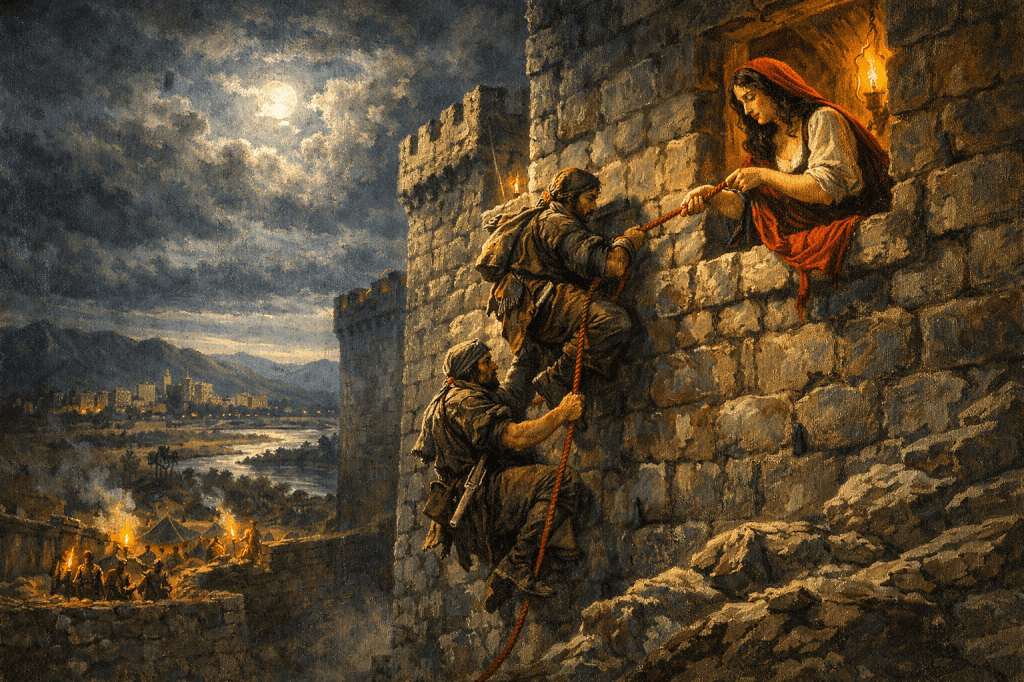
Joshua 2:17-21
- The sign of salvation — The scarlet cord functions like Passover blood: judgment passes over the marked house.
- Household gathered inside — Salvation is offered to all who come under Rahab’s roof.
- Rahab’s immediate obedience — She ties the cord in the window at once.
- Covenant boundaries — If anyone leaves the house, the spies are not responsible. Covenant grace includes covenant responsibility.
God delights to save families. Rahab becomes a living picture of how God gathers people into His household. This story should floor us. A woman, a gentile, a prostitute — is chosen by God, she wants to be included in the covenant of God, and immediately acts in obedience. And not only does she save her family, but she enters into God’s covenant family as a gentile, and marries into a family (Salmon), literally has Boaz as her son, then Obed, to Jesse, to King David. She ends up being great-great grandmother to the King, King David. Amazing.
Q: Think about how much grace was given to Rahab — what a gift. Do we see marks of grace in our own lives?
In the same way as Rahab, Scripture teaches that God’s grace leaves marks on us, not physical cords, but spiritual realities.
Here are the clearest “marks of grace” Scripture gives us:
- A changed heart — God promises, “I will give you a new heart and put a new spirit within you” (Ezekiel 36:26).
- New desires — We begin to hunger for God’s Word, God’s people, and God’s ways (1 Peter 2:2).
- Repentance — Not perfection, but a soft, responsive heart that turns back to God (Acts 11:18).
- Obedience that flows from faith — “Faith working through love” (Galatians 5:6).
- Love for God’s people — “We know that we have passed from death to life because we love our brothers and sisters” (1 John 3:14).
- Perseverance — A growing pattern of trusting God through trials (James 1:2–4).
No doubt there are many more, but these quickly come to mind!
Grace always leaves evidence.
SO — Where do we see God softening us, changing us, redirecting us, convicting us, comforting us, or growing us?
Joshua 2:22-24
- The spies return transformed — They left quietly & they return confidently.
- The opposite of Numbers 13 — Instead of fear, they proclaim faith:
“The Lord has handed over the entire land to us.” - God’s promise already fulfilled — Joshua 1:5 is happening in real time.
Joshua 2 it is the evidence that God is already keeping His promises before Israel takes a single step into the land.
Q: How does relying on God’s grace lead to security, and confidence in difficult times, just like the Hebrews here?
Relying on God’s grace gives us confidence because our security rests not in our strength, but in God’s faithfulness. The spies return boldly because they see that “the LORD has handed over the entire land to us” (Joshua 2:24). Their courage comes from God keeping His word, not from anything they accomplished. In the same way, when we remember God’s grace (His promises, His presence, His past faithfulness) we can face difficult moments with confidence. Grace reminds us that God goes before us, works while we wait, and finishes what He starts (Philippians 1:6). That is where real security comes from. Nothing in this world can offer that kind of security and confidence.
Wrap Up
Short Wrap‑Up Summary
- God goes before His people — Before Israel moves an inch, God is already at work in Jericho.
- Rahab’s faith — She hears of Yahweh’s works, believes, repents, and acts with bold allegiance.
- Providence guides every detail — The spies “happen” into Rahab’s house, hide in the mountains, and return with confidence.
- Covenant grace and responsibility — The scarlet cord marks salvation, but the household must remain inside.
- A transformed report — Unlike Numbers 13, the spies return full of faith: “The LORD has handed over the entire land to us.”
- Rahab’s redemption is stunning — A Canaanite prostitute becomes part of God’s people, part of David’s line, and part of Christ’s story.
Big takeaway:
Joshua 2 shows us that God’s grace runs ahead of us, faith responds with obedience, and God delights to redeem the most unlikely people for His purposes.
Questions:
- Where do you see God’s grace already at work ahead of you?
- How might God be calling you to respond with Rahab‑like faith and obedience this week?


Leave a comment