The lesson this week picks up in v12 — but we have some stuff in Joshua 5:13-6:1-11 that is important for our study. SO — let’s read it all first.
This part blows my mind… Joshua has just consecrated all the people, and he has circumcised all of the men. And after they celebrate Passover, Joshua goes out and he sees a man standing with his sword drawn in his hand. Joshua goes over to figure out the situation, and in v14 he literally learns that this man is an angel, he is a commander of the angel army of of Yahweh.
I know I say this all the time, but this is definitely one of those moments that I really wish the story kept going. We know that the angel tells him he is standing on holy ground but then the story stops. I mean obviously we know the outcome, this is the Lord’s Army that goes before them and destroys Jericho. But I really wish I knew more of the conversation, or what was going to Joshua’s mind, or something about this angel warrior. But that’s all we get, like so many spots where we see glimpses of the spiritual realm, it’s a glimpse and then the curtain is drawn.
Regardless I think it’s so awesome!
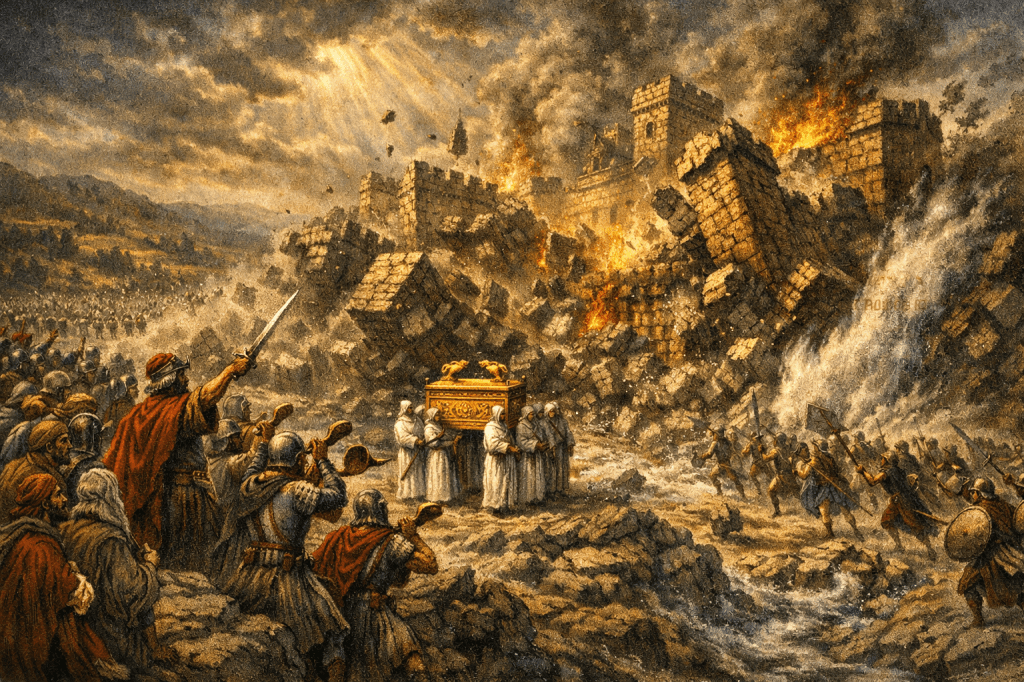
But then when we start to look at Joshua 6, more of the narrative unfolds. They learn their instructions, that they will be marching around the city once every day for six days, and the priests will bring rams horns, and carry the Ark of the Covenant around the city too. Then, on the seventh day they have specific instructions.
It’s so interesting though, in v10, Joshua wants them to remain silent as they walk around the city. Talk about obedience and trust — amazing!
Q: Think about what is involved, when you are learning to trust someone?
Look at how Yahweh here is calling for BIG obedience — but look what it demonstrates, they can ALWAYS trust in Him when they obey Him.
Q: Have you ever taken a “leap” by trusting God with something big?
Joshua 6:12-14
Q: Honest question… when have you felt like you’re just going in circles? Why is that so frustrating?
In this “battle” of Jericho, some priests carried rams horns and some the Ark. They led the people around the city completely everyday for six days — then quietly went back to their camp.
SURELY this felt weird, confusing, pointless, or maybe even sadistic?
Either way, they were called to be obedient, both to the Word of God, and Joshua — and they were. Thank goodness.
But we struggle sometimes like they surely did. Often the instructions we find from God are counterintuitive to what WE think it right, or best. But truthfully, Yahweh didn’t ask them for what they thought was best, He had a plan, and He wanted them to trust and obey.
It’s hard for us to trust and to obey. We want to see facts, we doubt, we over-think. BUT God does this at times. We see SO many examples in Scripture:
- Genesis 22 — Sacrificing Isaac
- Exodus 12 — Blood on doorposts for Passover
- Exodus 14 — Walk toward the sea with Pharaoh behind you
- Exodus 16 — Gather manna daily, no storing…
- Numbers 13-14 — Enter the land, with Giants
- Numbers 21:8-9 — Look at a bronze serpent to be healed
- Joshua 6 — March around Jericho for seven days
- 1 Kings 17 — A widow must feed Elijah first
- 2 Kings 5 — Naaman must wash seven times in the Jordan
Those are just a FEW of the OT ones, there are PLENTY in the NT too.
Q: So we have to ask, how do difficult or weird instructions from God, even just counter-cultural, test our faith?
- It exposes our human limits
- It requires us to trust God’s character, NOT circumstance
- It trains us to obey His Word, not trust our guts…
- We get to be in the stories of God’s faithfulness!
Joshua 6:15-19
This part is like the build up to the climax — they get up early, start at dawn, and they know they’re to walk around the city SEVEN times on this final seventh day (lest we forget in Scripture, seven is a number symbolizing completion or perfection).
We have to make note, in this passage — we have seven displayed prominently a few times:
- 7 trumpets/ram’s horns
- 7 priests
- 7 days
- 7 laps on the 7th day
I love Joshua’s words in v16, “Shout, for the LORD has given you the city”. It was always about the Lord. What Yahweh was doing among them, not what Joshua did, or what they did. What a great reminder and example. Little glimpse right here in battle, of great Biblical leadership.
But this time around, they are also given instruction to NOT take plunder for themselves. Particular items went into the Lord’s treasury, but that was all. They had a clear boundary, and a clear consequence for disobedience. A line is drawn, and again, they are expected to trust and obey — no matter whether hard or not.
Q: All this begs the question — why did Yahweh have the treasure set apart for Himself?
- God set apart the treasure of Jericho for Himself because Jericho was the firstfruits of the land — and the firstfruits always belong to the Lord.
- In a way, it’s a sacrifice — sacrificing what could have been theirs, but to the Lord, offering it to the Lord.
Joshua 6:20-21
Q: Who in life do you or have you trusted the most?
- Sometimes it’s a spouse
- Parents are common
- A best friend
- A long time confidant
We all have reasons for that trust we’ve placed in those people. But there are common things we can expect in those relationships.
- They have proven themselves trustworthy!
- They have kept their word, been honest, and truthful
- They’ve been consistent
- They known us well, and we know them well
- We have taken time to build that trust!
That matters much! Which begs the question, why do we sometimes struggle to trust the Lord, Yahweh?
> Perhaps, and I hate to say it, we don’t know Him as well as we think we do. Perhaps we have not confided, or trusted in small ways to build bigger trust, or not been honest and trustworthy ourselves. Perhaps we have not spent time with Him in prayer and studying His Word — rarely do we trust someone that we’ve spent little time with…
BUT — look at the Hebrews!
They show trust, they obey in this exercise of faith. This should encourage us too — Yahweh God is as good and faithful as He has said, He’s proven it over and over. Their step of faith accomplishes what God says it will.
Look at this –> the Hebrew word apparently that is used for “collapse” when speaking about the destruction of the walls of Jericho, apparently insinuates that the collapse began at the base of the walls….
Think about that. Not usually how “defeat” or “destruction” of city walls go… typically it’s the top, and slowly breaches come with pounding. These walls tumble, collapse from the bottom. Only Yahweh and His army can accomplish such a feat. This was ALL Him.
In the end, God’s people obeyed Him — and He worked out the victory. They simply had to trust Him, and obey His instruction. Praise the Lord.
Joshua 6:22-25
Rahab comes back in this last portion of our story, and it’s awesome! No one else is mentioned from Jericho by name, but Rahab is mention many times!
Q: Who is the most famous person in your family line?
Well I cannot think of one… I guess my Uncle went to HS with Brad Pitt, and I worked at Camp with a daughter of a pretty famous Christian singer/songwriter. But neither of those are family members… so — I got nothin’!
Nevertheless, imagine the legacy left by Rahab’s trust and obedience to Yahweh. Not only is her family spared and evacuated before the city is burned, but she is remembered for her faithfulness, she even is in the direct family line leading to King David a few short generations later. What a legacy of trust, obedience, and faith.
We often wish we had a noteworthy family story or a famous name in our lineage. But Rahab shows us something better — that a legacy of faith is worth more than any earthly reputation. What kind of spiritual legacy are you building for those who come after you?
Rahab’s story is a reminder that God loves to take people with no spiritual pedigree and write them into His redemptive story.
Rahab survives the conquest of Jericho, but more importantly, she becomes a pillar in the story of salvation, the lineage of faith!
Her legacy is faith.
And that is the kind of legacy any believer can leave.
Wrap Up
Think about how we struggle to trust God’s direction in times of flux, uncertainty, or waiting. How can we hold fast? How can we encourage others? How can we trust and obey when it’s hard? Anyone can when it’s easy — but God asks us to trust and obey regardless the circumstances.
Joshua 6 reminds us that the life of faith is rarely straightforward, predictable, or comfortable. God often leads His people in ways that stretch them, humble them, and teach them to trust His Word more than their instincts.
Israel marched in silence, obeyed without complete understanding, and watched God do what only He could do. Rahab believed before she saw, obeyed before she understood, and became part of a legacy far bigger than herself.
And in all of it, the victory belonged to Yahweh from beginning to end. The same God calls us to trust Him in our own seasons of waiting, circling, uncertainty, or fear — not because we see the outcome, but because we know His character. He has proven Himself faithful again and again.
Our part is the same as theirs: trust His Word, obey His voice, and watch Him work in ways we could never accomplish on our own. That is the legacy Joshua 6 invites us into — a legacy of faith that remembers who God is, rests in what He has promised, and responds with wholehearted obedience.


Leave a Reply