Remember, below is an auto-generated summary of my lesson transcript.
Farther below, you’ll see a link to the full transcript AND the audio file (those are ALL my words, just summary is auto-generated)
This is simply an attempt to share my notes from Sunday School, but speed up the process a bit.
Feedback is welcome!
Audio Recording of Lesson
Summary of Lesson (auto-generated)
This study focuses on Romans 11, specifically verses 11 through 24, addressing the relationship between Israel’s rejection of Jesus and the inclusion of the Gentiles. The central message is that Israel’s stumble was not a final fall but served to bring salvation to the Gentiles. This inclusion is intended to provoke Israel to jealousy, potentially leading them back to God. Paul emphasizes that God remains faithful to His covenant, using the parable of the olive tree to illustrate the unity of believers and the necessity of humility.
Key Biblical Themes and Metaphors
The Olive Tree Analogy
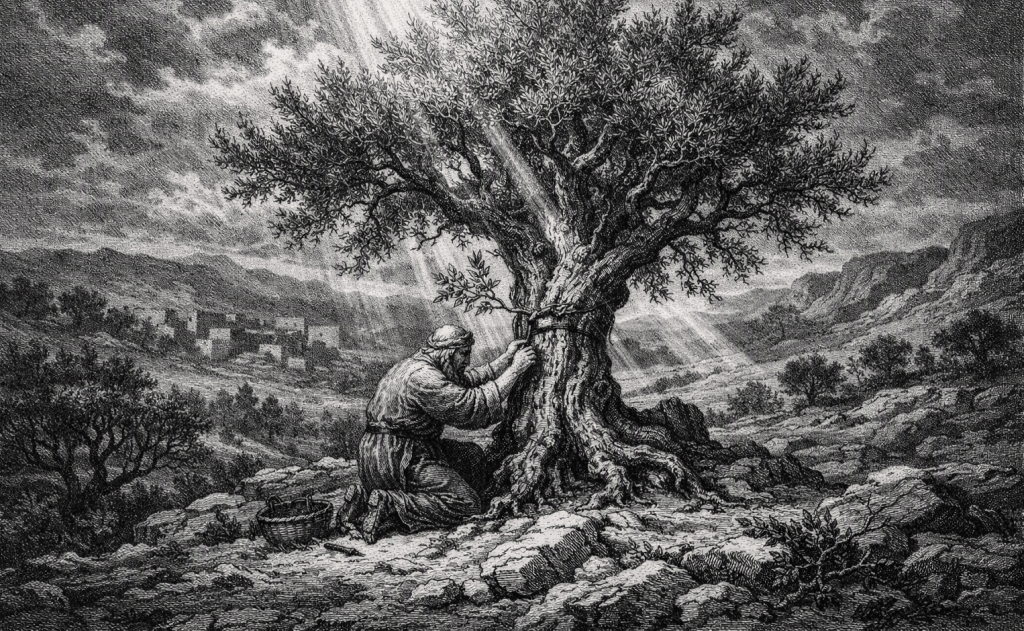
Paul uses the metaphor of a cultivated olive tree (Israel) and wild olive branches (Gentiles) to explain spiritual reality:
- Holy Root, Holy Branches: The root of the tree is holy (God’s covenant with Israel), and therefore the branches are sustained by this holiness.
- Grafting In: Gentiles, originally wild branches, were cut off from their natural condition and grafted into the cultivated tree to share in its rich root.
- No Boasting: Gentiles are warned not to boast over the broken-off natural branches. They do not support the root; rather, the root supports them.
- Warning of Severance: If God did not spare the natural branches (Israel) for unbelief, He will not spare the grafted branches (Gentiles) who fall into arrogance.
“When Can Rejection Be Good?”
The passage explores how Israel’s rejection of the Messiah paradoxically served God’s redemptive plan:
- Riches for the World: Israel’s transgression opened the door for the Gospel to spread to the Gentiles.
- Provocation to Jealousy: The goal was not just Gentile salvation, but to make Israel jealous of God’s favor toward the Gentiles, hoping this would lead to their eventual restoration.
- Life from the Dead: Paul suggests that if Israel’s rejection brought reconciliation to the world, their future acceptance of Christ would be even more momentous, akin to resurrection.
Practical Applications for Believers
Cultivating Humility
- Source of Fruit: Believers should attribute their spiritual fruitfulness solely to the “root” (God/Christ), not their own effort or status.
- Avoiding Spiritual Arrogance: Just as Gentiles were not to boast over Jews, Christians should avoid superiority complexes regarding church denomination, heritage, or spiritual maturity.
- Dependence on God: A branch cut from the tree dies. Similarly, believers cannot sustain themselves; they must remain abiding in Christ (referencing John 15) to live and bear fruit.
Understanding Divine Sovereignty and Restoration
- God Uses Failure for Good: The study highlights how God uses brokenness, sin, and failure to draw people back to Him. Examples include:
- John Mark: His conflict with Paul led to the expansion of missionary work and his eventual reconciliation with Paul.
- Charles Spurgeon: His struggles with depression allowed him to minister deeply to others’ pain.
- William Carey & John Newton: Formerly flawed individuals transformed into key figures in missions and hymnody.
- Joni Eareckson Tada: Her physical disability became a platform for global advocacy.
- Nothing is Wasted: God is sovereign and does not allow brokenness to have the final word. Even personal failures or difficult circumstances can be woven into kingdom purposes.
Discussion Prompts and Reflection
- Invitation and Exclusion: How does the unexpected “grafting in” of Gentiles compare to receiving unexpected invitations in life? How does God’s open invitation challenge the notion that anyone is beyond His love?
- Causes of Rejection: Common reasons for rejecting the Gospel include personal desire, a lack of understanding of sin, and a misunderstanding of grace (viewing it as cheapness rather than mercy).
- Personal Reframing: Believers are encouraged to reflect on which parts of their own story (failures, rejections, pain) God might currently be reframing for His glory.
- Hope for Restoration: The passage offers hope that no one is permanently outside the family of God. If Gentiles were grafted in against nature, how much more will natural branches (Israel) be grafted in again?
Conclusion
Romans 11 calls believers to a posture of humility, gratitude, and hope.
- Humility: Recognizing that spiritual life comes entirely from God’s root, not our own branches.
- Gratitude: Thanking God for being invited into the covenant family.
- Hope: Believing that God continues to work in the world, using even moments of failure to expand His kingdom and restore His people.
The session concluded with a prayer affirming dependence on God’s root and the belief that no one is beyond the reach of salvation.
Transcript of Lesson
Romans 11 Transcript (unedited)


Leave a Reply