Week 8 — we covered Nehemiah 7-8. Below is the Audio to listen to lesson, the transcript to read (unedited), and the auto-generated summary.
Audio Recording
Summary (auto-generated)
The session opened with a prayer emphasizing the value of pausing to reflect on God’s Word. The group focused on Nehemiah 7 and 8, highlighting the transition from physical rebuilding to spiritual renewal. While Nehemiah 7 contains a detailed list of returnees (verses 7–73), the study concentrated on the first five and last few verses, as well as the entirety of Chapter 8.
Nehemiah 7: Leadership and Inventory of the Body of Christ
Leadership and the Fear of God
- Appointed Leaders: After the wall was rebuilt and guardians (singers, Levites) were appointed, Nehemiah placed Hanani and Hananiah in charge of Jerusalem.
- Qualities of Leadership: Hananiah was chosen because he was “a faithful man and feared God more than many.” This highlights that the fear of the Lord is more important than the fear of people, enemies, or external consequences.
- Ongoing Vigilance: Nehemiah instructed that city gates remain closed until midday and that guards be posted. This demonstrates that completing a major project (the wall) does not mean “letting up” on discipline or security; maintenance and vigilance are required to sustain the work.
The Significance of the Genealogical List
- God’s Personal Attention: The recording of thousands of names serves as a reminder that no name is ordinary to God. Even though the group was a small, unimportant remnant compared to the surrounding empires, God valued each individual.
- Faithfulness Over Comfort: The list demonstrates the faith of those who chose to leave the security and comfort of their exile to return to a ruined house.
- Generosity of the People: Verse 66 details significant financial contributions (gold, silver, tunics) given by the heads of families to fund the temple work, showing a heart of voluntary service rather than mere obligation.
Nehemiah 8: The People’s Hunger for the Word
The Gathering (Verses 1–8)
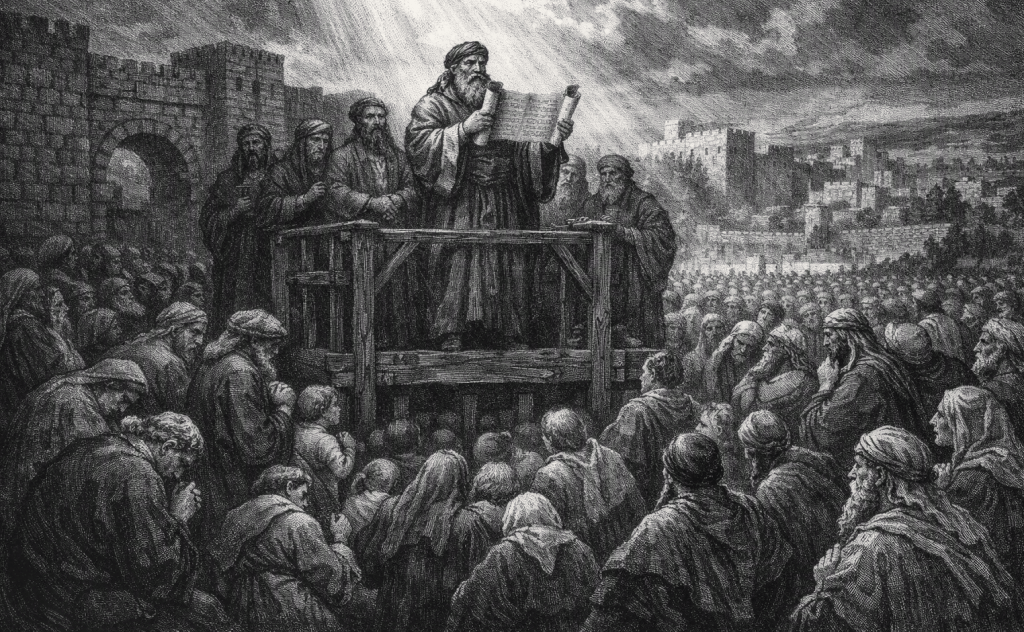
- Unified Purpose: The people gathered “as one man” at the square in front of the Water Gate, marking a rare moment of complete communal unity.
- Request for the Law: Rather than having the reading forced upon them, the people explicitly asked Ezra the scribe to bring out the Book of the Law of Moses.
- Posture and Attentiveness:
- Ezra stood on a wooden podium, and all the people stood in response, showing deep respect and anticipation.
- The reading lasted from early morning to midday (approx. 5–7 hours).
- The people were attentive and hungry for the Word, a stark contrast to modern distractions and passive listening.
- Exposition and Understanding: The Levites stood beside Ezra to explain the text, ensuring the people not only heard but understood the Law.
The Community’s Response (Verses 9–12)
- Conviction Leading to Joy: Hearing the Law caused the people to weep and mourn over their sin. However, Nehemiah, Ezra, and the Levites redirected their response:
- Instruction: “This day is holy… Do not mourn or weep.”
- Action: They were told to eat, drink, and send portions to those who had nothing.
- Theological Truth: The leaders emphasized that the joy of the Lord is strength.
- Conviction vs. Shame: The study distinguished between constructive conviction (which leads to repentance and a turn to God) and destructive shame (which leads to despair). The goal is repentance, not self-pity.
Obedience in Action (Verses 13–18)
- Discovery of the Feasts: Upon reading the Law, the people discovered they had neglected the Feast of Booths (Tabernacles), which had not been observed since the time of Joshua son of Nun.
- Immediate Obedience: They eagerly went out to gather materials (olive, myrtle, and palm branches) and built booths on their roofs, in their courtyards, and in public squares.
- Sustained Engagement: They read the Law daily for seven days and held a solemn assembly on the eighth. This highlighted a high view of Scripture: even in the middle of a project or routine, God’s commands take ultimate authority.
Key Themes and Application Questions
1. Leadership and Fear of the Lord
- Question: Do I fear God more than I fear people, consequences, or criticism?
- Application: True leadership—in families, schools, and the church—is rooted in faithfulness to God rather than a reaction to external threats or the desire for personal acclaim.
2. Engagement with Scripture
- Question: When Scripture is read, do I lean in with a posture of reverence, or do I tune out?
- Application: In a distracted world, “attentiveness” requires intentional focus. Standing, removing devices, and seeking to understand (not just hear) are vital for spiritual growth.
3. Conviction vs. Despair
- Question: Am I allowing the Word to lead me to repentance, or am I wallowing in self-condemnation?
- Application: God’s Law reveals sin, but the response should be to the mercy found in Jesus, resulting in joy and obedience, not despair.
4. Joy as Strength
- Question: Do I treat the joy of the Lord as optional?
- Application: The joy of the Lord is a tangible strength that sustains believers through suffering and sorrow. Unlike happiness, which depends on circumstances, this joy is rooted in relationship and is available even in difficult times.
5. Obedience to Inconvenient Commands
- Question: What is one command of God’s Word I know I have neglected (e.g., the Feast of Booths)?
- Application: Like the returnees, believers should be eager to obey even when it is inconvenient (e.g., giving up comfort for a few days to dwell on God’s faithfulness).
Conclusion
The session concluded with a prayer thanking God for the clarity of His Word and asking for a heart that is hungry to hear, understand, and obey. The group affirmed that while Nehemiah and Ezra were ordinary humans, God used their faithfulness to bring spiritual revival to a divided people. Believers are challenged to pursue this same “spiritual hunger” and to allow Scripture to reveal Jesus and lead them to active obedience.timeline and demonstrating God’s provision under pressure.


Leave a Reply