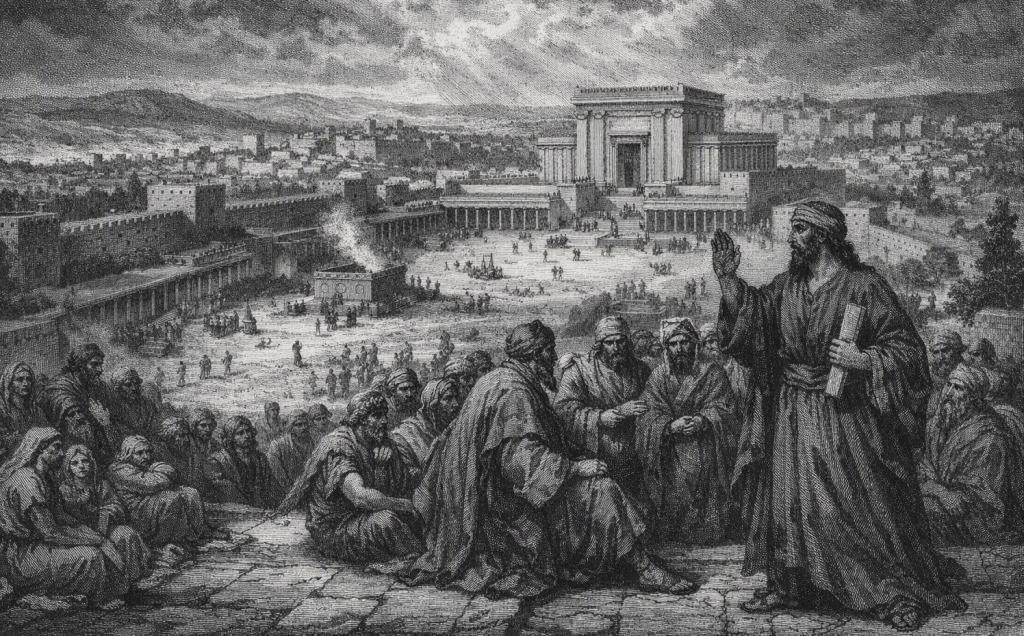
Week 7 — we covered Nehemiah 5-6. Below is the Audio to listen to lesson, the transcript to read (unedited), and the auto-generated summary.
Audio Recording
Summary (auto-generated)
This document summarizes a small group Bible study session focusing on Nehemiah 5 and 6. The session examines the dual threats faced by the exiles: internal social injustice and external political intimidation. It highlights the role of the “fear of God” in maintaining integrity and resisting the enemy.
Chapter 5: Internal Threat and Social Injustice
The Crisis
The people of Israel faced a severe famine that led to widespread economic exploitation. The wealthy nobles charged interest to the poor and enslaved their countrymen to secure food and pay taxes. This was viewed as a betrayal of the community, as the people had just returned from exile to rebuild God’s presence.
Nehemiah’s Response
Nehemiah responded to the oppression with a balanced approach modeled on the “fear of God”:
- Righteous Anger: He was “exceedingly angry” upon hearing the complaints.
- Deliberation: He “seriously considered the matter” before acting, ensuring his response was wise rather than reactive.
- Confrontation: He called a large assembly and publicly accused the nobles of profiting from their own people. He challenged them to “walk in the fear of our God” and not give the enemy a reason for reproach.
- Restitution: The nobles agreed to return fields, vineyards, and money, swearing an oath before the priest.
Leadership by Example
Nehemiah demonstrated integrity by refusing to take the governor’s allowance (money and food) that his predecessors had exploited. For 12 years, he personally funded his household, maintaining his focus on the wall’s construction. He concluded the chapter with the prayer: “Remember me favorably, my God, for all I have done for this people.”
Chapter 6: External Intimidation and Deception
Refusing Distraction
After the wall was rebuilt, external enemies (Sanballat, Tobiah, and Geshem) realized they needed a new strategy to stop Nehemiah.
- Repeated Decoys: They sent four messages inviting Nehemiah to the Valley of Ono for peace talks, aiming to distract him from his work so they could attack.
- Rumors: A fifth letter spread false rumors that Nehemiah was plotting a rebellion and seeking to become king.
- Consistency: Nehemiah responded with the same refusal every time, maintaining his loyalty to his task.
The Deceptive Prophet (The Temple Trap)
A prophet named Shemaiah claimed God spoke to him, telling Nehemiah to flee to the Temple because he was being attacked.
- The Trap: Although the Temple was a place of protection, Nehemiah realized something was wrong: he was a layman, not a priest, and entering the Holy Place would have been a sin.
- The Result: Nehemiah recognized this was a plot to coerce him into sin and discredit his reputation. He did not panic or flee, trusting that God would protect him.
Resolution
- The wall was completed in 52 days.
- The surrounding nations were intimidated, recognizing the work was accomplished by God.
- Despite success, internal corruption remained, as many Judahite nobles were still allied with Tobiah through family ties.
Key Spiritual Themes
Internal vs. External Sin
Internal sin is often harder to resist than external pressure because it is subtle and invisible. Sin within the community allows outsiders to judge the people of God and disbelieve their message, threatening the work of the Church more effectively than active opposition.
Managing Anger and Outrage
Nehemiah provides a model for processing anger:
- Acknowledge the sin and feel genuine anger toward it.
- Pause and “seriously consider the matter” to avoid acting irrationally.
- Call out the sin and address the root issue.
- Establish and enforce a plan for restitution.
The Fear of God (Reverence)
The “fear of the Lord” is defined not as terror, but as reverence that drives a person to please God rather than men. It acts as a barrier against manipulation, ensuring that leaders remain above reproach and that decisions are made for God’s glory rather than human approval.
Personal Application Questions
The study concluded by asking participants to reflect on their own lives:
- Integrity: Do we maintain our character when no one is watching, especially when it costs us something?
- Influence: Do we have any “Tobiah” influences in our lives—relationships that remain comfortable but quietly work against our obedience to God?
- Ultimate Fear: Do we genuinely fear and submit to God more than we fear the opinions, approval, or criticism of other people?
- Faithfulness: God demands faithfulness over perfection; are we striving to be faithful in the small, unseen details of daily life?
Community Connection
During the final prayer, the group shared a parallel between Nehemiah’s situation and the founding of their own church. The church had urgently acquired land to avoid a federal takeover by a Savings and Loan Association. The legal work was completed exactly 52 days before the authorities arrived, mirroring Nehemiah’s timeline and demonstrating God’s provision under pressure.


Leave a Reply